
Search
Additional Links Contact Us- Phone: +1 (704)-588-1794
- Toll-Free: +1 (800) 269-7409
- Fax: +1 (704) 588-1821
- Email: [email protected]


ProMach is your partner from start to finish. Our product brands are grouped into distinct business lines that make the most sense to our customers, covering every function of the production line: Filling, Bottling & Capping, Decorative Labeling, Flexibles & Trays, Pharma, Handling & Sterilizing, Labeling & Coding, Robotics & End of Line, and Systems & Integration.
learn more


Growing environmental concerns are shaping consumer behavior. Today, shoppers favor products designed with sustainability in mind, often choosing eco-friendly options over cheaper, less responsible alternatives.
Looking ahead, this trend shows no signs of slowing. The beverage industry has a significant opportunity to adopt sustainable packaging, not only to reduce environmental impact but also to capture the growing market of environmentally conscious buyers.
This article dives into the key sustainability trends and insights shaping the beverage industry, retailers and packaging suppliers in 2026.
The cautious consumer of 2026 requires a high level of value before making any purchase. They’re unlikely to spend carelessly on physical goods and are more drawn than ever to sustainable alternatives. Two major trends are contributing to this shift:
Consumer priorities
Environmental awareness
Let’s start with a look at shifting consumer priorities.
The 2026 consumer base has become increasingly discerning about their spending. Many people are looking to save more money and create additional income through side hustles as a safety net. In fact, over 30% of consumers now employ money-saving strategies such as:
Switching to lower-priced brands
Buying private-label products
Opting for promotions
Instead of focusing purely on seeking the cheapest possible option, many Americans have redefined what ‘value’ means to them by prioritizing trust and consistency over novelty or premium status. This is especially true of Millennials and Gen Z. Studies show these demographics are massive drivers of sustainable purchasing.
This shift toward purchasing sustainable products can also be seen in how consumers view eco-friendly goods.
Recent surveys show an uptick in eco-conscious purchasing, especially in the United States. According to GlobeScan’s 2025 survey, 49% of Americans said they purchased an environmentally friendly product in the past month, up from 43% in August 2024.
Additionally, PwC’s 2025 Voice of the Consumer Survey suggests many consumers are growing concerned about food safety and environmental impact. The survey reveals that these concerns are “most pronounced among younger generations, particularly Millennials,” signaling that younger shoppers are helping steer demand toward healthier and more sustainable choices.
For example, there are rising concerns about plastic waste, individual carbon footprints and packaging recyclability. And with plastic waste doubling in the past 20 years, these concerns have never been stronger.
Social media and public campaigns are amplifying sustainability expectations as well. #BeatPlasticPollution, for example, reached thousands of companies, investors and individuals across online spaces.
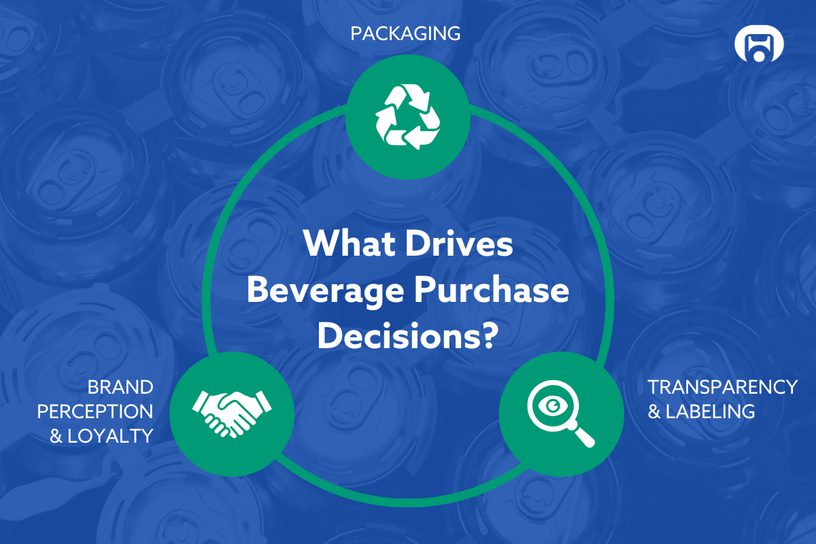
Sustainability drives purchases, but in what ways does it drive beverage purchase decisions? There are three major categories:
Ensuring that your packaging is 100% biodegradable, recyclable or reusable will differentiate you from other producers. Your commitment to the environment will ease the consumer’s conscience.
Plus, it has never been easier to make that change as a beverage producer. Multipacking solutions providers like Roberts PolyPro offer affordable and sustainable packaging solutions for bottles, cans and beyond.
Consumers will pay more for sustainable options from organizations they trust. Choosing a trustworthy, eco-friendly brand when they do decide to treat themselves is a high priority. Case in point: Over 60% of consumers say that environmental sustainability influences what brands they trust.
Another way to drive beverage purchases through sustainable packaging is to communicate sustainability efforts to customers.
Studies show customers are more likely to buy from your brand if you are clear and transparent about your sustainability practices. In fact, 71% are more likely to believe your sustainability claims if they are printed directly on your packaging. If you’re proud of your practices, say so right on the can or bottle.
The shift toward sustainability is growing in the beverage industry, affecting manufacturers, retailers, distributors, and packaging suppliers alike.
For beverage manufacturers, the pressure to innovate has never been greater. Brands that develop sustainable containers will reduce environmental impact and strengthen their appeal to environmentally conscious consumers. Plastics that biodegrade naturally or multipacks that reduce excess material are effective ways to stand out.
Retailers and distributors are feeling the impact as well. Shelf space is increasingly competitive, and demand for sustainable brands is rising. This means that beverage lines with clear sustainability credentials and efficient packaging solutions are more likely to be stocked and promoted, providing a competitive advantage.
The growing need for sustainable high-density polyethylene (HDPE) handles, can carriers and recyclable materials also presents new avenues for revenue among packaging suppliers.
Suppliers that invest in sustainable technologies and materials can position themselves as essential partners to manufacturers and retailers, capturing market share while supporting the industry’s broader shift toward sustainability.
With sustainability on the mind in 2026, here are a few trends to watch to stay competitive in the beverage space.
Beverage manufacturers are adopting multipack products that are completely biodegradable. For example, all of Roberts PolyPro’s can and bottle multipacks can be made with plastics that are 100% biodegradable*.
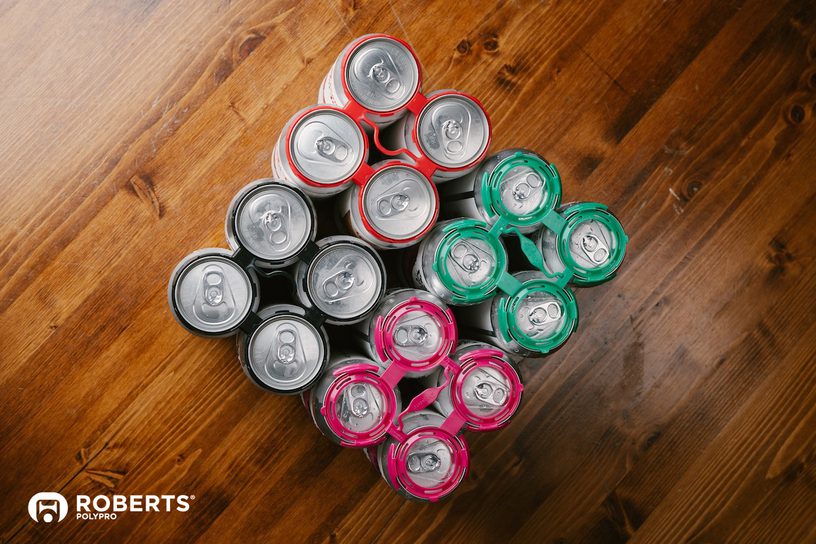
If packaging like this is discarded, it will decompose just like any other organic material, making it safer for the environment.
While post-consumer recycled (PCR) materials have been used in packaging for years, expanding state-level regulations are accelerating their adoption.
Designed to give new life to recovered plastics and support a more circular economy, PCR requirements are being embraced by states including California, Connecticut, Maine, and New Jersey. For example, California Assembly Bill 793 mandates that plastic beverage containers contain at least 25% PCR content as of 2025, with that requirement increasing to 50% by 2030.
Roberts PolyPro recently expanded its lineup to include PCR options, as many customers view recycled content as essential to meeting their sustainability goals.
For some, PCR supports corporate initiatives and evolving consumer expectations; in regions with strong recycling infrastructure, it also helps close the loop by turning recovered plastics back into functional packaging.
Keeping your materials minimalistic and lightweight also contributes to sustainability in many ways. When done right, lightweight design uses less plastic while maintaining durability.
A lightweight philosophy will reduce the load on shipping as well, making transport lower cost and lower-energy, saving money and lowering your carbon footprint all in one go.
Sustainability is no longer optional and is a key driver of consumer decisions in 2026. Ignoring this shift risks losing relevance, so make sure to embrace eco-conscious practices that strengthen both trust and sales.
Investing in sustainable packaging is one such practice. Biodegradable multipacks, recycled materials and lightweight designs reduce environmental impact and appeal to conscientious consumers. Clear, transparent communication about these efforts displayed on your packaging will further amplify your brand’s credibility.
All this is possible with Roberts PolyPro. Our sustainable multipack handles can help your brand reduce waste and meet consumer expectations, all while building a lasting positive impact on the planet.
Want to learn more about our sustainable packaging solutions? Contact our team today to find the optimal can or bottle carrier solution for your goals.
*Following rigorous scientific tests, an independent agency demonstrated that our LDPE and HDPE products completely biodegraded, without any false-positives or false-negatives, within 28 and 56 weeks, respectively.